Showing posts with label Seattle. Show all posts

September 23, 2015

Duwamish meanders: A river ran through it

For millennia, the Duwamish River sustained a diverse ecosystem of fertile floodplain forests, marshes and tideflats in what is now South Seattle. The geologic record shows that the Duwamish valley was created by glaciers, then repeatedly transformed by catastrophic volcanic mudflows, earthquakes and floods.

This 1922 photo shows the Duwamish River transforming into the Duwamish Waterway.
The Smith Tower is in the distant upper right and a young Harbor Island can be seen at the end of the channel.
File photo / The Seattle Times.

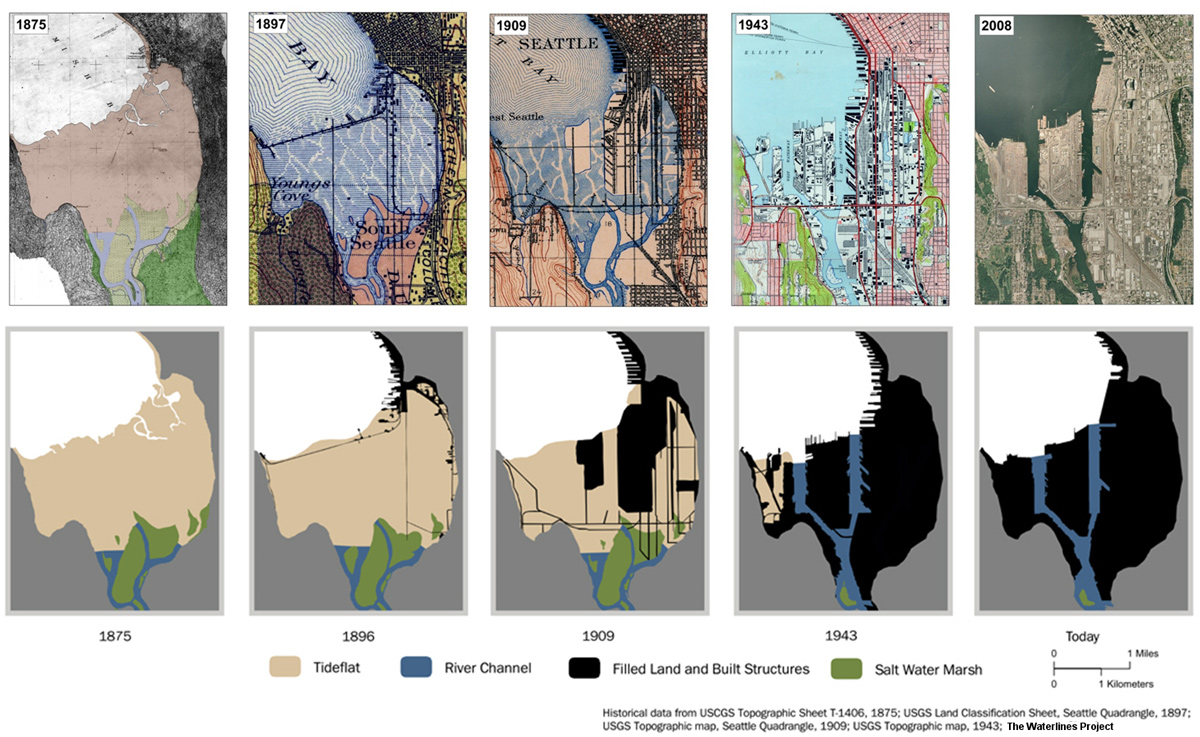
Arguably the greatest transformation the river experienced in recent history was wrought by human engineering. In the early 20th century, a series of major civil engineering projects diverted the comingled flows of three rivers out of the valley, lowered Lake Washington nine feet, shortened the river by four miles, dredged the river into a navigable waterway, filled in the old meanders, and built Harbor Island—the largest manmade island in the world at the time—by washing hillsides into the tide flats. This was largely undertaken for flood control efforts, navigation and commercial interests.

While the pace and scale of the industrialization of the Duwamish valley rivals that of any major city, it also came at a cost. To Coast Salish people, the expansive tidal mud flats and the wetlands adjoining the meandering river were a valuable resource. The channels, islands and shorelines were all populated with names that recorded sacred landscapes, uses, historical memories and meanings.

The engineered changes to Seattle’s shoreline disrupted ecosystems, eliminated traditional food sources (including a productive salmon fishery) and completely reconfigured Coast Salish people's relationship with this place. The land became Seattle’s industrial and commercial heartland and an engine of economic growth for the city. The factories built on top of the old meanders sustained a vibrant economy through two world wars, helping grow Seattle and the Pacific Northwest into what it is today.

The transformed valley continues to provide thousands of jobs. Major efforts are also underway to clean up the river to make the river safe for fish and people alike. The Duwamish Tribe, which plied these waters for millennia, once again have a longhouse along its banks.

January 27, 2015

Origin of the Seahawks logo: The story unfolds


It’s been one year since we first explored the connection between a Native mask from the Pacific Northwest and the original Seattle Seahawks logo. What a year it has been! Now, as the Seahawks prepare to "re-Pete" their visit to the Super Bowl, here’s what we’ve learned so far about the mask that inspired the logo.

Photo courtesy of the Hudson Museum.

October 13, 2014

Seattle's ghost shorelines

By Peter Lape, Amir Sheikh, and Don Fels

Someday soon, Seattle’s downtown waterfront will look very different than it does today. The City of Seattle is replacing our crumbling seawall, and perhaps Bertha will resume digging the tunnel to replace the rickety, looming and loud Alaska Way Viaduct, scheduled to be torn down in 2016.

These changes create the potential to reconnect to the Elliot Bay shoreline, a main reason the city was established here in the first place. Planning continues for a re-imagined waterfront, and architects, designers, planners and politicians are starting to share their ideas with Seattlites.

An architectural rendering shows what a Pioneer Square beach at the foot of Washington Street could look like.
Photo: Courtesy of James Corner Field Operations and City of Seattle, Adapted from The Seattle Times’ September 12, 2014 article titled “Seattle’s new waterfront: What it might look like and why.”

March 07, 2014

Next steps for Seattle mammoth tusk

UPDATED 3.20.14

The Seattle Mammoth had a Twitter account up and running within a day of its tusk being discovered, but when it comes to next steps for the tusk itself, the pace may be a bit more... well, glacial.

Step 1: Stabilize

"For every day you spend collecting something, you can spend weeks,
months or even years getting the preparation work done."
Bruce Crowley, Burke Museum Paleontology Lab Manager

March 04, 2014

Diggin' the South Lake Union Mammoth

By Dave DeMar

On Tuesday, February 11, 2014, an employee of Transit Plumbing, Inc. discovered a Columbian mammoth tusk at a South Lake Union construction site in Seattle. I had heard about its discovery that day but hadn’t given it much thought beyond “you never know when or where fossil discoveries are going to turn up.”


The Columbian mammoth is Washington's state fossil and had tusks
up to 15 feet long. These mammoths ranged across North America
until the last glacial retreat about 11,000 years ago.
Image by Charles Knight, 1922, public domain.

The following Thursday around 8:30 a.m., I received a text message from Dr. Christian Sidor, Curator of Vertebrate Paleontology at the Burke Museum and University of Washington Associate Professor of Biology, asking if I’d like to help excavate the mammoth tusk. “Sure!” I immediately responded, thinking what an adventure it would be to dig up an ice age animal in the middle of a city.

February 07, 2013

My Month Without Plastic: I Survived

 
The plastic waste generated during my month without plastics.
I made it! I survived a month "without" plastic. I managed to mostly avoid purchasing new plastic but still left a small trail of plastic waste behind (see the photo to the right).

It’s less than I expected, which is somewhat of a relief, but I still cringe when I think about this waste still being around for decades after this challenge is over.

We forget about our trash rather quickly when we throw something “away,” but “away” is still somewhere. One of the walls in the Burke's Plastics Unwrapped exhibit is covered with 3,000 plastic bags–the number used every single second by people like me, who hadn’t thought about the consequences of common consumption. I believe as people who can make choices for ourselves, we have a duty to become more aware of our impact and to make a change.

February 05, 2013

Parrington artifacts: A collector's story


Vernon L. Parrington in his office at the University of
Oklahoma, ca. 1905. Photograph courtesy of Sarah Parrington.
Objects in museums hold many stories—often of their makers and users, and also, sometimes, of their collectors.

That's the case with several beautiful Native American artifacts recently donated to the Burke Museum from the family of Vernon Louis Parrington, a longtime English professor at the University of Washington (UW) in the early 1900s.

Parrington was born in Illinois in 1871. He graduated from Harvard College in 1893 and taught English for four years at Emporia College in Kansas before moving on to teach at the University of Oklahoma.


January 31, 2013

My Month Without Plastic: Wrapped Up

By Samantha Porter

Not only have I had to rethink how and what types of foods I purchase during this month without plastics challenge, but it's also made me rethink other aspects of my life. Have you ever noticed how many everyday items you use are either made of plastic or wrapped up in it?

Plastics are literally everywhere! They're surrounding my shampoo, kitchen sponges and laundry detergent. They're in my clothes, face wash (what do you think those little microbeads are?) chewing gum, and dental floss. Even the little plastic aglet on the end of my shoe laces. It's a fact: plastics exist in my life and in my home.

I certainly can't avoid all plastics and there are some that I don't want to avoid. Can you imagine having a glass shampoo bottle in the shower? That's a lawsuit waiting to happen. Even though there are some plastics I can't easily avoid, I've found ways to lessen the collateral damage of my overall consumption.

January 23, 2013

My Month Without Plastic: Unexpected Nutrition Overhaul


By Samantha Porter

In last week's post, I was just starting to realize how much effort and planning it would require for me to avoid plastic waste while shopping for groceries. This process is a bit clumsy at first, but I'm slowly getting the hang of it.

What will I eat??

Before leaving for the store, I think through exactly what I'm going to purchase so I make sure to bring the right jars and reusable bags with me to carry my groceries. Though it is a relative hassle, it's given me the opportunity to be more mindful about what I eat.

November 07, 2012

Studying bursts of diversification in tropical bats

Sharlene Santana holds a Lophostoma silvicolum bat.

Sharlene Santana is an evolutionary biologist and the new curator of mammals here at the Burke Museum. She studies how behavior, diet, anatomy and function result in bursts of diversification in tropical bats – mostly from Panama, Costa Rica and Venezuela.

Sharlene was born and spent most of her life in Venezuela. Growing up in the tropics fostered her love for animals and interest in their diversity.

Some of the tropical forests where Sharlene has worked no longer exist because they have been cut down. While Sharlene releases most of the bats she studies in the field, she collects some specimens to help preserve the biodiversity of these increasingly threatened habitats. In her research today and other studies in the future, these specimens in collections will help answer questions that haven’t even been asked.

I recently sat down with Sharlene to ask her why and how she studies bats.

June 22, 2012

A little "Eye Spy," anyone?

Want to play a little "Eye Spy?" Test your nature knowledge with these sneak preview photos featured in the International Conservation Photography (ICP) Awards exhibit at the Burke Museum through November 25, 2012.

Eye spy a mellow mamma and her curious calf, who was very "friendly" with the photographer when he took their picture near an island in the South Pacific known for the same quality. Where are they?
Photo by Ryan Hellard (zoomed in for Eye Spy)

May 22, 2012

Unearthing a Fossil: Giant Turtle Edition


We're often asked what it takes to get a fossil out of the ground and ready for research and museum display. The answer: it can take weeks, months or even years worth of work.

In this short time-lapse video, Burke Museum fossil preparator Bruce Crowley walks us through the process with our giant turtle fossil—from digging it out of the ground and wrapping it in a jacket, to chipping away tiny bits of rock with a series of miniature jack hammers.


April 04, 2011

The Sea-Tac sloth


Washington State is home to many amazing fossil discoveries. You may have heard about some finds that sound like tall-tales, like a giant sloth found in an unexpected place. So you ask the Burke Museum:

Q: Is it true that a giant ground sloth was found at Sea-Tac International Airport?

A: Yes! Fifty years ago remains of a giant ground sloth, termed Megalonyx, were unearthed as construction crews were installing a lighting system along a runway at Sea-Tac airport. Nearly two-thirds of the sloths bones were perfectly preserved, with only the skull and some of the neck and limb bones missing. Casts were taken from another Megalonyx specimen and were used to complete the skeleton that you can see on display at the Burke Museum.

Megalonyx and other types of giant sloths roamed North America during the Pleistocene epoch (2.5 million to 12,000 years ago) eating plant materials, roots, and tubers and fending off attacks from saber-toothed cats.

For history buffs, the first Megalonyx fossil discovered in the United States was by the third president of the United States, Thomas Jefferson. He found it in 1796 in a saltpeter mine in what is now West Virginia.

Want to learn more about the Sea-Tac Sloth? Watch this video created by Mary Jean, Kelsie and Rachel, students in the University of Washington’s COM460 class.


The Burke Museum partners with the Seattle PI's Big Blog to answer commonly asked questions about the natural and cultural history of our region. This post originally appeared on the Big Blog on April 2.

Have a question to Ask the Burke? Send it here!

July 09, 2009

New podcast features stories in stone

Posted by: Julia Swan, Communications
A new podcast was added to the Burke's Interactive Web site this morning. It features David Williams, a geologist and an educator at the Burke, who recently published the book Stories in Stone: Travels Through Urban Geology and who will be presenting about that book at the museum on July 29.

I really enjoyed listening to David talk about how building stone, which can be found in nearly all urban environments (certainly Seattle!), can be indicative of so much: regional geologic history, fashion trends, the relative affluence of a city, etc. In recording this podcast with David, I learned that there are buildings in downtown Seattle made out of stone that is literally more than 1 billion years old. That's pretty amazing!

Listen to David's stories and learn more for yourself about Seattle's urban geology here.

April 30, 2009

Alaska-Yukon-Pacific Exposition celebrations are kicking into gear

Posted by: Karin Hoffman, Communications

This year Seattle is celebrating the centennial of the 1909 Alaska-Yukon-Pacific Exposition (AYPE), a world’s fair that showcased the resources of the region and celebrated the development resulting from the 1897 Yukon Gold Rush. The fair was held on the University of Washington campus, and while only three original buildings from AYP remain – Architecture Hall, Cunningham Hall and the Engineering Annex – much of the landscape designed by Richard Charles Olmstead is still recognizable.
From April to May volunteers from the Friends of Seattle’s Olmstead Parks will be giving tours that highlight Olmstead’s vision to create a campus in which "the magnificent views...will...be by far the greatest features...” Anyone who has sat at Drummheller fountain on a clear, sunny day and taken in the view of Mount Rainer would agree. It’s magnificent!

The tours will take place on the last Saturday of every month and start at 10 am at the Burke Museum. The 90 minute tours are free, but registration is required. For more information check out the Web site for Friends of Seattle’s Olmstead Parks.

April 13, 2009

Discovering Seattle's past through maps

Posted by: Karin Hoffman, Communications

150 years ago Pioneer Square in downtown Seattle was a lagoon and thought of as the best place to catch flounders. Early settlers quickly realized that flat, and dry land for that matter, was a limited resource. After 1853 Seattle’s early pioneers slowly started filling the lagoon with whatever they could find: sawdust from Yesler’s Mill, building remains from the Great Fire of 1889, gravel and garbage. These materials formed the foundation from which Seattle was born.

How do we know this? Through research using maps, illustrations, photographs, and written historical accounts, most of which are held in the public domain.

So what is the connection to the Burke? The Waterline’s Project! An interdisciplinary team, lead by Peter Lape, Burke curator of archaeology, Amir Sheikh, staff member on the Puget Sound River History Project, and Donald Fels, a researching artist have developed The Waterline’s Project to explore how Seattle’s landscape has changed over time. The Waterline’s Project is a fascinating way to explore the history of Seattle through maps.

The project website , which was recently posted on the Burke’s homepage, is just the first step in providing the public with a unique way of examining the history of Seattle. In addition to the new website the team is currently in the planning stage of creating outdoor exhibits, electronic broadcasts for handheld devices, and an installation of lines in Pioneer Square marking past shorelines.

Check it out!


Photo: Bird's eye view of the city of Seattle, Puget Sound, Washington Territory, 1878. A.L. Bancroft & Co., lithographersDrawn by E.S. GloverLibrary of Congress Geography and Map Division, Washington, D.C

AddThis