By Tom Kaye
The sky was crystal clear as my wife Carol and I geared up for our first day “on expedition” at Petrified Forest National Park in northern Arizona. This trip was particularly exciting for us because Petrified Forest had recently acquired a huge new tract of land and we, along with several colleagues from the Burke Museum, were the first team going in to look for fossils!
Specifically, we were looking for fossils of huge predators from 210 million years ago during the Triassic Period. We knew that most of the fossils we found would belong to extinct groups known as aetosaurs and phytosaurs. The former sported armor plates and foot-long spikes to ward off attacks. The latter were the Triassic equivalent of crocodiles: aquatic predators that you didn’t want to mess with.
Hunting for fossils isn’t as glamorous as it’s cracked up to be. It was never less than 100 degrees on the desert floor thanks to the sun’s reflection. We wore SPF 50 sunblock made for children so it didn’t sting when the sweat runs in your eyes. We were almost never in sight of anyone else. And the best fossils are ALWAYS the farthest from the truck.
So, I hope you enjoy the pictures and know that you’re getting the best parts of the trip right here!

Showing posts with label field work. Show all posts
Showing posts with label field work. Show all posts
November 04, 2014
June 21, 2013
Bringing a Triceratops to Seattle
Dinosaurs capture the attention of museum visitors of all ages. (Watch our 30-second Dino Shake video to see just how much a few of our staff members and their kids love dinosaurs.)
Here at the Burke, we have several dinosaurs in our galleries, but we also maintain a vertebrate paleontology collection with more than 50,000 specimens. Nearly 90% of these specimens are fossil mammals, with the remaining 10% comprising dinosaurs, fossil fish, fossil birds, fossil marine reptiles, and other fossil reptiles.
Researchers study these specimens to learn about the life before us, as do University of Washington (UW) undergraduate and graduate students taking paleontology and evolution courses.
So, when a team led by Christian Sidor, curator of vertebrate paleontology at the Burke, discovered a Triceratops in a rock formation in eastern Wyoming, he set out to bring more of the iconic dinosaur to Seattle.
So, when a team led by Christian Sidor, curator of vertebrate paleontology at the Burke, discovered a Triceratops in a rock formation in eastern Wyoming, he set out to bring more of the iconic dinosaur to Seattle.
 |
| A young visitor admires a Triceratops in the Burke gallery Photo by Carol Swales |


June 03, 2013
What really killed the dinosaurs? K-12 teachers are helping us find out
By Gregory P. Wilson
Many of us think of extinction as a terrible process that strips us of amazing biodiversity. On one hand, that’s certainly true. It’s estimated that more than 99.9% of living things that once existed are now extinct! On the other hand, extinctions often benefit the survivors.
As a paleontologist with the Burke Museum and University of Washington, I examine the evolution and ecology of early mammals in the context of major events in the earth's history.
 |
| Dr. Wilson in the field. |
Marine fossils from around the world contain important clues to understanding this mass extinction event. But relevant terrestrial fossils, including dinosaurs, can only be found in a handful of places.
One of the most famous and intensively studied fossil sites is the Hell Creek badlands in northeastern Montana, where the type specimen of T. rex was discovered in 1902 by paleontologist Barnum Brown. In the 1980s, this area became a testing ground for the ‘Alvarez hypothesis’, which posited that an asteroid wiped out the dinosaurs in a geologic blink of an eye.
November 07, 2012
Studying bursts of diversification in tropical bats
 |
| Sharlene Santana holds a Lophostoma silvicolum bat. |
Sharlene Santana is an evolutionary biologist and the new curator of mammals here at the Burke Museum. She studies how behavior, diet, anatomy and function result in bursts of diversification in tropical bats – mostly from Panama, Costa Rica and Venezuela.
Sharlene was born and spent most of her life in Venezuela. Growing up in the tropics fostered her love for animals and interest in their diversity.
Some of the tropical forests where Sharlene has worked no longer exist because they have been cut down. While Sharlene releases most of the bats she studies in the field, she collects some specimens to help preserve the biodiversity of these increasingly threatened habitats. In her research today and other studies in the future, these specimens in collections will help answer questions that haven’t even been asked.
I recently sat down with Sharlene to ask her why and how she studies bats.
October 04, 2011
Research in the Jungles of Costa Rica
Museum collections come from a variety of different sources. Sometimes they are donated by individuals and families, other times they are donated by other museums, cultural organizations or state agencies, and often, volunteers, researchers, and employees of the museum go out and collect themselves. These trips can take you down the street or around the world.
Regan Dunn, a UW graduate student who works in Burke Curator of Paleobotany Dr. Caroline Strömberg's lab, was in Costa Rica this summer conducting original research in the field. By looking at the shape of plant cells (phytoliths) and amount of sunlight those plants receives, Regan is trying to determine if there is a correlation between the two. By analyzing current ecological environments, Regan hopes to reconstruct and better understand past environments.
While Regan was in Costa Rica, Dr. Strömberg and Regan worked with the Burke Museum’s “Girls in Science” summer camp. Specifically, the girls examined phytoliths, learned about Paleoecology, and even conducted research on Tiger Mountain that replicated Regan’s field work. At the end of the day on the mountain, the girls came back to the Burke and talked with Regan about her research via Skype. They talked about what life in the field is like and even compared findings. Watch the video below to find out more – those rubber boots would work great for Seattle-based field work, too!
Posted by: Andrea Barber, Communications
Regan Dunn, a UW graduate student who works in Burke Curator of Paleobotany Dr. Caroline Strömberg's lab, was in Costa Rica this summer conducting original research in the field. By looking at the shape of plant cells (phytoliths) and amount of sunlight those plants receives, Regan is trying to determine if there is a correlation between the two. By analyzing current ecological environments, Regan hopes to reconstruct and better understand past environments.
While Regan was in Costa Rica, Dr. Strömberg and Regan worked with the Burke Museum’s “Girls in Science” summer camp. Specifically, the girls examined phytoliths, learned about Paleoecology, and even conducted research on Tiger Mountain that replicated Regan’s field work. At the end of the day on the mountain, the girls came back to the Burke and talked with Regan about her research via Skype. They talked about what life in the field is like and even compared findings. Watch the video below to find out more – those rubber boots would work great for Seattle-based field work, too!
Posted by: Andrea Barber, Communications
July 18, 2011
Volunteer Spotlight: Paleontology Edition
This month's Volunteer Spotlight features the work of Don, a volunteer in the Burke Museum's Paleontology division.
Jessica, volunteer coordinator: Hi Don! Tell me a little bit about the volunteer work you do at the Burke.
Don: I volunteer in Paleontology in the basement at the Burke, but I get to spend a lot of time outdoors in the field collecting specimens, which I’ve been doing on and off since 1983.
Jessica: How did you end up volunteering at the Burke Museum?
Don: Originally I received my MFA from UW and worked in the gardens on campus, and I got involved after I found a fossil out at the Swauk Formation in Kittitas County in 1983. I didn’t know what it was, so I brought it in to the Burke and Bev Witte, one of the long time volunteers here, immediately identified it as part of a turtle from the Middle Eocene. Since then I have continued to hunt for fossils, volunteer at the Burke and learn about paleontology. I volunteered from 1983-95 and then moved across the country, but continued to come back and volunteer for short periods before finally moving back to the area in 2009 and volunteering regularly since then.
Jessica: What do you like most about volunteering at the Burke?
![]()
Don: I like field work the most. Usually I do field work locally, but most recently I went to Colorado for a week to work at the Denver Museum Snowmastodon Project with several other volunteers and paleontologists Kirk Johnson and Ian Miller. We found bones from mastodons, sloths and tiger salamanders.
Jessica: What is the funniest thing that has happened while volunteering?
Don: Usually I collect by myself, so there aren’t too many funny stories to tell! I collected for a week at the Snowmastodon Site for the Denver Museum in June. Paleontologist Kirk Johnson was very loud and encouraging to the volunteers, and was working hard while digging for bones right alongside us. At one point he yelled out to motivate the volunteers, “Bring me the head of a sloth!” and not too long after, someone found one!
Jessica: What would surprise people about what you do?
Don: I think people would be surprised about the size a collection can reach over a period of time. I volunteer at the Burke about 50 hours per week, plus field work. I have worked on developing the collection related to the Tertiary period, primarily at the Swauk Formation where I found the partial turtle, but I have collected throughout Washington, Oregon, and British Columbia.
Before modern technology, we used to heave fossils onto the photocopier and send the copies to researchers around the country. This helped identify the Burke Museum among researchers, and bring graduate students and academic interest to the museum. The Burke Museum has come a long way, and now we have three curators in paleontology – paleobotany, vertebrate paleontology, and invertebrate paleontology.
Jessica: Briefly describe your most memorable project.
Don: One of the biggest finds I have made was one of my first – the partial turtle found at the Swauk Formation. Since then I have continued to focus my collecting on that area, collecting on Chuckanut Drive at first and then moving inland. We are accumulating a collection of animal footprints including the Terror bird from the foothills around Mt. Baker, similar to one found in the Burke Museum lobby right now.
Thanks, Don, for all of your contributions to the Burke Museum and for sharing your wonderful stories with us!
Posted By: Jessica Newkirk, Volunteer Coordinator
Jessica, volunteer coordinator: Hi Don! Tell me a little bit about the volunteer work you do at the Burke.
Don: I volunteer in Paleontology in the basement at the Burke, but I get to spend a lot of time outdoors in the field collecting specimens, which I’ve been doing on and off since 1983.
Jessica: How did you end up volunteering at the Burke Museum?
Don: Originally I received my MFA from UW and worked in the gardens on campus, and I got involved after I found a fossil out at the Swauk Formation in Kittitas County in 1983. I didn’t know what it was, so I brought it in to the Burke and Bev Witte, one of the long time volunteers here, immediately identified it as part of a turtle from the Middle Eocene. Since then I have continued to hunt for fossils, volunteer at the Burke and learn about paleontology. I volunteered from 1983-95 and then moved across the country, but continued to come back and volunteer for short periods before finally moving back to the area in 2009 and volunteering regularly since then.
Jessica: What do you like most about volunteering at the Burke?

Don: I like field work the most. Usually I do field work locally, but most recently I went to Colorado for a week to work at the Denver Museum Snowmastodon Project with several other volunteers and paleontologists Kirk Johnson and Ian Miller. We found bones from mastodons, sloths and tiger salamanders.
Jessica: What is the funniest thing that has happened while volunteering?
Don: Usually I collect by myself, so there aren’t too many funny stories to tell! I collected for a week at the Snowmastodon Site for the Denver Museum in June. Paleontologist Kirk Johnson was very loud and encouraging to the volunteers, and was working hard while digging for bones right alongside us. At one point he yelled out to motivate the volunteers, “Bring me the head of a sloth!” and not too long after, someone found one!
Jessica: What would surprise people about what you do?
Don: I think people would be surprised about the size a collection can reach over a period of time. I volunteer at the Burke about 50 hours per week, plus field work. I have worked on developing the collection related to the Tertiary period, primarily at the Swauk Formation where I found the partial turtle, but I have collected throughout Washington, Oregon, and British Columbia.
Before modern technology, we used to heave fossils onto the photocopier and send the copies to researchers around the country. This helped identify the Burke Museum among researchers, and bring graduate students and academic interest to the museum. The Burke Museum has come a long way, and now we have three curators in paleontology – paleobotany, vertebrate paleontology, and invertebrate paleontology.
Jessica: Briefly describe your most memorable project.
Don: One of the biggest finds I have made was one of my first – the partial turtle found at the Swauk Formation. Since then I have continued to focus my collecting on that area, collecting on Chuckanut Drive at first and then moving inland. We are accumulating a collection of animal footprints including the Terror bird from the foothills around Mt. Baker, similar to one found in the Burke Museum lobby right now.
Thanks, Don, for all of your contributions to the Burke Museum and for sharing your wonderful stories with us!
Posted By: Jessica Newkirk, Volunteer Coordinator
March 16, 2010
How old are dinosaurs? Older than we thought!
Here’s some breaking news: dinosaurs may have lived much earlier than previously thought!
Burke Museum curator of vertebrate paleontology Christian Sidor and a team of paleontologists recently discovered that a dinosaur-like creature called Asilisaurus kongwe lived as many as 10 million years earlier than the oldest known dinosaurs.
Burke Museum curator of vertebrate paleontology Christian Sidor and a team of paleontologists recently discovered that a dinosaur-like creature called Asilisaurus kongwe lived as many as 10 million years earlier than the oldest known dinosaurs.

Asilisaurus is part of a sister group to dinosaurs known as silesaurs. Silesaurs are considered dinosaur-like because they share many dinosaur characteristics but still lack key characteristics all dinosaurs share. The relationship between silesaurs and dinosaurs is analogous to the close relationship of humans and chimpanzees. Sidor and his colleagues concluded that dinosaurs might also have lived at the time of Asilisaurus – bumping back the age of the oldest dinosaurs by 10 million years. The Asilisaurus fossil bones were recovered from a single bone bed in southern Tanzania, making it possible to reconstruct a nearly entire skeleton. The creature would have stood about 1.5 to 3 feet tall and 3 to 10 feet long, weighing between 22 to 66 pounds. The description of the new species appeared in a paper published March 4 in Nature. The lead author is Sterling Nesbitt, at The University of Texas. Sidor is among the co-authors.
An article in the University Week gives more detail about the new species. Christian Sidor was also recently featured on NPR’s Science Friday, in an interview about the discovery. Click here to listen to his interview.
Posted by: MaryAnn Barron Wagner, Communications
Photos: (center) A life recreation of Asilisaurus kongwe. Marlene Hill Donnelly, Field Museum; (right) Christian Sidor excavates a fossil from the Manda beds in Tanzana in 2007, photo by L. Tsuji.
February 05, 2010
Studying paleobotany in Patagonia
Grass is something we all take for granted; it covers 1/3 of the Earth’s land surface, and provides many different sources of food for humans and other animals as well. But when did grasses first appear on the planet? How do they respond to varying climates? And, who/what ate them? These are just a few of the questions that Caroline Strömberg, Curator of Paleobotany at the Burke, seeks to answer when she travels to Patagonia, Argentina this month.
 Why Patagonia? Paleontologists believe open grasslands first appeared in South America 30-million years ago, long before they emerged on other continents, based on evidence of large, herbivorous mammals called “meridiungulates” that appear in the fossil record at that time. These mammals had long legs and high-crowned teeth that seem specialized for grass-eating.
The research conducted by Caroline and her colleagues Matt Kohn (Boise State University), Rick Madden (Duke University), and Alfredo Carlini (Museo de La Plata, Argentina) can help answer other important questions that are currently affecting the world today. By analyzing the relationship between meridiungulates and vegetation, the gaps filled in the fossil record through the Patagonia research can help us better understand why, and how, both vegetation and animals respond to climate change.
So good luck, Caroline! We look forward to your return and learning more from your findings!
Posted By: Andrea Barber, Communications
 Why Patagonia? Paleontologists believe open grasslands first appeared in South America 30-million years ago, long before they emerged on other continents, based on evidence of large, herbivorous mammals called “meridiungulates” that appear in the fossil record at that time. These mammals had long legs and high-crowned teeth that seem specialized for grass-eating.
The research conducted by Caroline and her colleagues Matt Kohn (Boise State University), Rick Madden (Duke University), and Alfredo Carlini (Museo de La Plata, Argentina) can help answer other important questions that are currently affecting the world today. By analyzing the relationship between meridiungulates and vegetation, the gaps filled in the fossil record through the Patagonia research can help us better understand why, and how, both vegetation and animals respond to climate change.
So good luck, Caroline! We look forward to your return and learning more from your findings!
Posted By: Andrea Barber, Communications
February 27, 2008
This is how we do it
Posted by: Rebecca Durkin

Q: How does a fossilized Tyrannosaurus rex premaxilla get from this point:

to this point?


Most vertebrate fossils are found enclosed in solid rock, with just a little bit of bone exposed. While it can take days to carefully collect a fossil in the field, it can often take weeks, months, or years to uncover enough of the fossil back in the lab so that it can be studied or exhibited!
At this year’s Dino Day event on Sat., March 1, fossil preparator Bruce Crowley (pictured above) will be up in the galleries working on the T. rex bone live in front of visitors. You can watch him up close as he uses miniature jackhammers, sand blasters and chisels to remove the enclosing rock and expose the fossil. It’s a fascinating process and one that rarely gets the spotlight in the glamorous world of fossil hunting. Don’t be afraid to ask him about his work – he doesn’t bite!
More on the fossil…
The premaxilla was put through a CAT Scan to produce this neat all-around view (the white parts are plaster):
Join us at Dino Day for a glimpse at this hunk of T. rex (actual fossil portion highlighted in brown below) and lots more dino and fossil goodness.
 - Rebecca
Photos:
Top: Burke paleontologists uncovered the T. rex fossil in Wyoming, 2007. Photo by Christian Sidor.
Middle: Example of a T. rex premaxilla fossil, National Museum of Nature and Science, Japan. Photo by Christian Sidor.
Bottom: Bruce Crowley prepares a brontothere fossil bone. Photo by Rebecca Durkin.
December 04, 2007
Dino-mummy!
Posted by: Karyn Gregory

In 1999, paleontologists unearthed a mummified dinosaur complete with much of its skin and tissue intact. On Monday, Dec. 3, this find was revealed to the public.

In 1999, paleontologists unearthed a mummified dinosaur complete with much of its skin and tissue intact. On Monday, Dec. 3, this find was revealed to the public.
 muscular structure and show us how the dinosaur’s skin really looked.
November 29, 2007
Cruisin' the Fossil Freeway
Posted by: Rebecca Durkin
 What do you get when you take one Seattle-born paleontologist, add one wacky Northwest artist, stick ‘em in a pick-up truck, and set them off on an adventure? Cruisin’ the Fossil Freeway, the new book by Kirk Johnson and Ray Troll, takes us on an “epoch” journey across the western states at 65 mph in search of fossils.
 What do you get when you take one Seattle-born paleontologist, add one wacky Northwest artist, stick ‘em in a pick-up truck, and set them off on an adventure? Cruisin’ the Fossil Freeway, the new book by Kirk Johnson and Ray Troll, takes us on an “epoch” journey across the western states at 65 mph in search of fossils.
 The hilarious duo will be reading from their new book and signing copies at the Burke tonight at 7 pm – tickets are $5 at the door and free to members.
Want a taste of what you’re in for? Check out their brief interview on NPR’s All Things Considered, discussing “Jurassic Pork” and “PNS” (Paleo Nerd Syndrome). Then join us tonight for the real scoop!
- Rebecca
June 19, 2007
Field Work Doesn’t Always Work Out as Planned
 Spider curator Rod Crawford shares the ups and downs of one of his latest field adventures...
 My most ambitious (and, with the price of gas, expensive) spider collecting field trip of the year was to be a Memorial Day Weekend expedition to northeast Washington, in collaboration with Larry McTigue, an old friend from my caving days who wanted to hunt for new caves in the limestone deposits. The plan was to start in southern
Photo: Female Evarcha proszynskii from Wolfe Camp Road by Rod Crawford
May 02, 2007
Spider collecting trip
Posted by: Rod Crawford
Burke spider curator (and author of Spider Myths!) Rod Crawford takes us along on a recent spider collecting trip…

 The little tree clump (isolated among miles of sagebrush) that I'd found on aerial photos turned out to be
 Douglas maple, a nice surprise; I'd expected more common trees like cottonwood or pine. At least three rare spider species were among those sifted from the leaf litter. Laurel
Laurel spotted the best spider of the day, Misumenops importunus (one of the flower crab spiders) lying in wait for pollinators among the flowers on a gooseberry bush. It was the first record of the species from eastern Washington! Laurel was most impressed by a large male jumping spider, Phidippus johnsonii, with a bright red abdomen, but he could see her coming and refused to be collected. I later found one in a retreat under a board at dusk.
The only humans we saw all day were two young ladies ascending the canyon on muleback and horseback. The natural flora and fauna of the canyon (the latter including many bees, bee flies, and beetles) all contributed to a most satisfying day. And our collections (including three species brought back alive for rearing) filled in yet another of the many blanks on the Washington spider distribution maps.
Of course, immersion in nature means encounters with not only herbivores and predators, but also parasites - cattle ticks were more common than some people would have found quite comfortable. But the true naturalist can't let such small things detract from fullest enjoyment of the first spring field trip!
More photos and other details on this trip can be seen on this album page from the Spider Collector's Journal site.
Photos, from top to bottom:
Stone Quarry, photo by R. Crawford
Phidippus johnsonii, male, photo by R. Crawford
Misumeops lepidus on a balsamroot flower, ready to embrace a bee, photo by L. Ramseyer
Burke spider curator (and author of Spider Myths!) Rod Crawford takes us along on a recent spider collecting trip…

So far this year, every time I had a chance for a spider collecting trip, it rained. But bad luck doesn't last forever. The atmosphere finally became cooperative in mid-April and local natura
list Laurel Ramseyer (recently arrived from Michigan via Massachusetts) wanted to find out what spider collecting was like. Our first joint site wasStone Quarry Canyon
list Laurel Ramseyer (recently arrived from Michigan via Massachusetts) wanted to find out what spider collecting was like. Our first joint site was
 The little tree clump (isolated among miles of sagebrush) that I'd found on aerial photos turned out to be
 Laurel spotted the best spider of the day, Misumenops importunus (one of the flower crab spiders) lying in wait for pollinators among the flowers on a gooseberry bush. It was the first record of the species from eastern Washington! Laurel was most impressed by a large male jumping spider, Phidippus johnsonii, with a bright red abdomen, but he could see her coming and refused to be collected. I later found one in a retreat under a board at dusk.

The only humans we saw all day were two young ladies ascending the canyon on muleback and horseback. The natural flora and fauna of the canyon (the latter including many bees, bee flies, and beetles) all contributed to a most satisfying day. And our collections (including three species brought back alive for rearing) filled in yet another of the many blanks on the Washington spider distribution maps.
Of course, immersion in nature means encounters with not only herbivores and predators, but also parasites - cattle ticks were more common than some people would have found quite comfortable. But the true naturalist can't let such small things detract from fullest enjoyment of the first spring field trip!
More photos and other details on this trip can be seen on this album page from the Spider Collector's Journal site.
Photos, from top to bottom:
Stone Quarry, photo by R. Crawford
Phidippus johnsonii, male, photo by R. Crawford
Misumeops lepidus on a balsamroot flower, ready to embrace a bee, photo by L. Ramseyer
January 08, 2007
He's ba-ack...(with STUFF!)
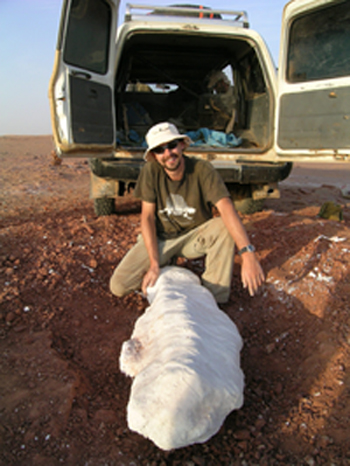
Dr. Christian Sidor, vertebrate paleontology curator, has returned from his expedition to Niger with a bag of goodies for the Burke’s paleontology collection. He unveiled his research team’s fossil finds on Monday to a bevy of reporters and photographers, so look for the news in your local Seattle papers.
All of the fossils collected by Christian’s team are from the Late Permian period, approximately 260 million years old (that’s 40 million years older than the first dinosaurs!), representing an exciting array including:
•The nearly complete backbone of a new, large, plant-eating reptile called a pareiasaur.
•The skeleton of a small, new reptile called a captorhinid.
•The lower jaw of the large captorhinid reptile Moradisaurus (a fossil named by French paleontologists in 1967).
•The first plant fossils from the Upper Permian of Niger.
•A 60-foot fossil tree log, the first of this size from the Permian of West Africa.
•The first fossil footprints and trackways of land-living animals from the Permian of West Africa.
These fossils represent life on Earth during a time when all the continents were aligned as one supercontinent, Pangea. Yet what the team found are animals that are unique, despite this shared geography. If it’s not geography that isolated these animals, then what was it that allowed them to evolve differently from other reptiles found across Pangea? Christian and his team, which includes UW undergraduate, Tara Smiley, are investigating the role of climate in this phenomenon.
Below: Just some of the fossils from Niger awaiting treatment in the fossil prep lab

Subscribe to:
Posts (Atom)