Showing posts with label Archaeology. Show all posts

September 23, 2015

Duwamish meanders: A river ran through it

For millennia, the Duwamish River sustained a diverse ecosystem of fertile floodplain forests, marshes and tideflats in what is now South Seattle. The geologic record shows that the Duwamish valley was created by glaciers, then repeatedly transformed by catastrophic volcanic mudflows, earthquakes and floods.

This 1922 photo shows the Duwamish River transforming into the Duwamish Waterway.
The Smith Tower is in the distant upper right and a young Harbor Island can be seen at the end of the channel.
File photo / The Seattle Times.

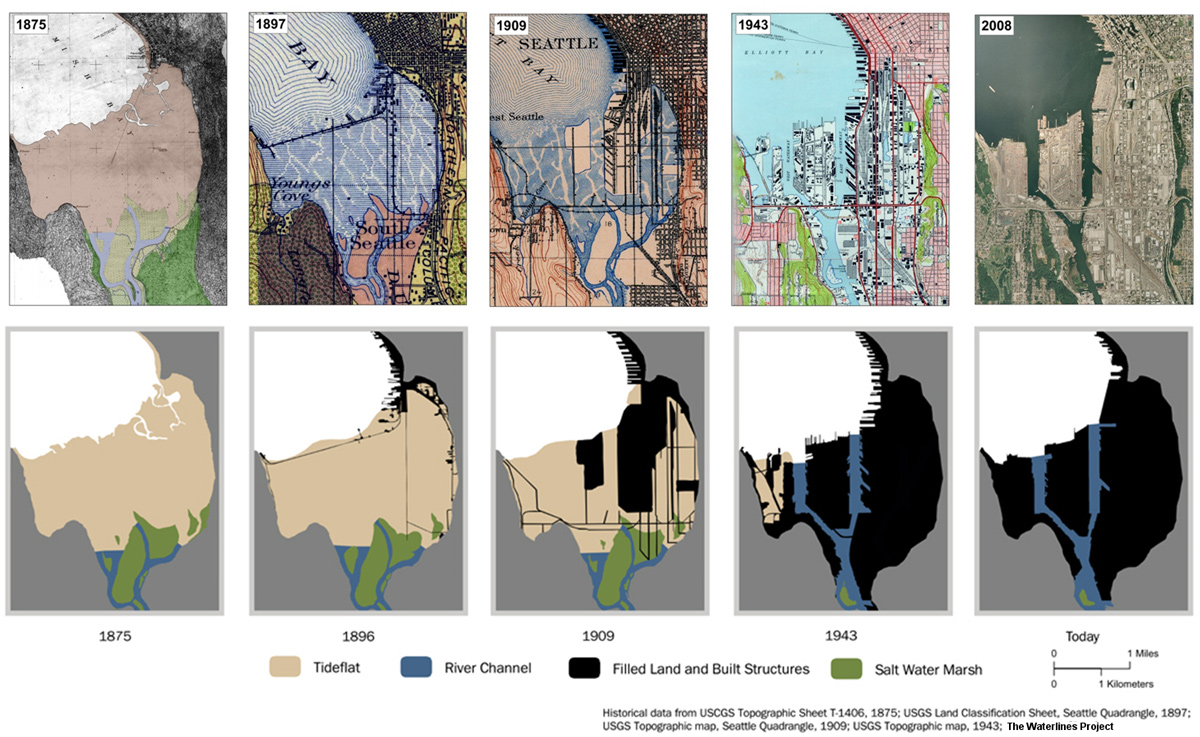
Arguably the greatest transformation the river experienced in recent history was wrought by human engineering. In the early 20th century, a series of major civil engineering projects diverted the comingled flows of three rivers out of the valley, lowered Lake Washington nine feet, shortened the river by four miles, dredged the river into a navigable waterway, filled in the old meanders, and built Harbor Island—the largest manmade island in the world at the time—by washing hillsides into the tide flats. This was largely undertaken for flood control efforts, navigation and commercial interests.

While the pace and scale of the industrialization of the Duwamish valley rivals that of any major city, it also came at a cost. To Coast Salish people, the expansive tidal mud flats and the wetlands adjoining the meandering river were a valuable resource. The channels, islands and shorelines were all populated with names that recorded sacred landscapes, uses, historical memories and meanings.

The engineered changes to Seattle’s shoreline disrupted ecosystems, eliminated traditional food sources (including a productive salmon fishery) and completely reconfigured Coast Salish people's relationship with this place. The land became Seattle’s industrial and commercial heartland and an engine of economic growth for the city. The factories built on top of the old meanders sustained a vibrant economy through two world wars, helping grow Seattle and the Pacific Northwest into what it is today.

The transformed valley continues to provide thousands of jobs. Major efforts are also underway to clean up the river to make the river safe for fish and people alike. The Duwamish Tribe, which plied these waters for millennia, once again have a longhouse along its banks.

October 13, 2014

Seattle's ghost shorelines

By Peter Lape, Amir Sheikh, and Don Fels

Someday soon, Seattle’s downtown waterfront will look very different than it does today. The City of Seattle is replacing our crumbling seawall, and perhaps Bertha will resume digging the tunnel to replace the rickety, looming and loud Alaska Way Viaduct, scheduled to be torn down in 2016.

These changes create the potential to reconnect to the Elliot Bay shoreline, a main reason the city was established here in the first place. Planning continues for a re-imagined waterfront, and architects, designers, planners and politicians are starting to share their ideas with Seattlites.

An architectural rendering shows what a Pioneer Square beach at the foot of Washington Street could look like.
Photo: Courtesy of James Corner Field Operations and City of Seattle, Adapted from The Seattle Times’ September 12, 2014 article titled “Seattle’s new waterfront: What it might look like and why.”

August 11, 2014

Explore the past and present near San Juan Island's American Camp

For the past 20 years, Julie Stein, executive director of the Burke Museum and a professor of Archaeology at the University of Washington, has led walking tours on the southern edge of San Juan Island in Washington’s Strait of Juan de Fuca within the Salish Sea. The people who come on these tours are curious about one thing: stories of people and place. And on Julie’s tour, those stories extend back thousands of years.

This year marked what may be Julie’s last tour, but if you didn’t get to go on one, you can still draw on your powers of observation and curiosity—as well as this DIY (do-it-yourself) tour guide—to enjoy a rich investigation into the past and present of San Juan Island.

Julie Stein, executive director of the Burke Museum, has offered archaeology-based walking tours on San Juan Island for the past 20 years, but the premise of her tours can be readily adapted by anyone—it all starts with questions. Photo credit: John Howell, Cedar River Group

April 10, 2014

Object in focus: A mug made from a walrus

The journey from walrus to mug is actually shorter than you might think, as a few objects in the Burke's collection show.

First, the mug.


Photo credit: Richard Brown Photography
Object ID: Cat. No 1-2177
Gift of Lucille Christ


This mug was found in the mid-1950s when some children were digging in a backyard in Seattle's Laurelhurst neighborhood, but the mug probably originated in Alaska over 100 years ago.

Around the turn of the 20th century, mugs like this were made by Alaskan Native carvers to sell to tourists. This mug was most likely sold or traded to someone in Alaska who then brought it down the coast to Seattle. From there, the mug either got lost or thrown away and became buried.

After the mug was found, it was eventually donated to the Burke's archaeology collection, where it lives today.

But what about the walrus connection?

December 03, 2013

Connecting Philippine and Puget Sound Communities

A week before Typhoon Haiyan battered the central Philippines, seven heritage enthusiasts from Palawan Island came to Seattle to learn about archaeology, community-based museums and heritage tourism, and to visit firsthand with people of another culture, the Suquamish Tribe.

Suquamish Tribal Elder Betty Pasco and Robert Arevalo share
a laugh at the end of their hike on the Cape Flattery Trail.
Photo by Wade Trenbeath.

May 07, 2012

Science News Roundup: (Mostly) archaeology edition

Some highlights from science news in the past couple weeks:

Penguin from space.
Scientists count penguins from space: Scientists have completed the first count of emperor penguins from space by estimating the number of birds using Very High Resolution (VHR) satellite images of Antarctica and collaborating the counts with ground and aerial counts. (Note that these were penguins being counted from space, NOT penguins from space being counted. :-) Using satellite images allows more accurate counts of the penguins, due to their harsh environment.

DNA points to common ancestors of modern cattle: Modern cattle are probably descended from a herd of just 80 animals that lived 10,500 years ago. An international team of scientists extracted DNA from early domesticated cattle bones thanks to archaeological digs in Iran. The Near East is where cattle, goats, pigs and sheep were first domesticated, and the DNA analysis provides important clues to how and why animals were domesticated.

Human ancestors used fire 1 million years ago: In a cave in South Africa, an international team of scientists found evidence that human ancestors used fire as long as 1 million years ago. The evidence consists of "microscopic traces of wood ash, alongside animal bones and stone tools ... found in a layer dated to one million years."

As if the Great Pacific Garbage Patch wasn't enough: Wind pushes plastic below the ocean's surface, a University of Washington oceanographer recently noticed. Since we currently estimate how much plastic garbage is in the ocean by skimming the surface, this means there's even more garbage clogging the ocean than we thought. Instead of just floating on the surface, the oceanographer found plastic at every depth.

-----------------------
A note about Science News Roundups: these short blurbs are based on press releases and, therefore, represent one perspective on a news item. If you're interested in a story, be sure to look for more news pieces that feature a variety of sources, including experts who were involved in the work as well as experts in the same field who weren't.

December 16, 2011

Archaeology at an Insane Asylum

Imagine the Archaeology Department’s surprise when they got a call from the WA State Archives requesting help with 12 boxes of artifacts from the Insane Asylum of Washington Territory. 

Turns out that along with the historic hospital records from what has become Western State Hospital in Lakewood, WA, some artifacts were also transferred to the State Archives. The State Archivist realized these collections belonged in an appropriate repository, and contacted the Burke Museum.

But why are there artifacts coming from the Western State Hospital, the State’s psychiatric hospital? Due to the proposed construction of a new wing in the 1980s, archaeologists from the Office of Public Archaeology on the University of Washington campus were called in to investigate the land that is part of the Fort Steilacoom Historic District. 

Archaeologists identified, among other things, remnants of a wooden structure dating to circa 1850-1890 and a privy dating to circa 1850-1920. This site was originally a Steilacoom band winter settlement site. In the 1830s, the site was occupied by Joseph Thomas Heath, who ran a Hudson’s Bay Company farm. It was taken over by the U.S. Army in 1849 when Heath succumbed to measles. The U.S. Army established Fort Steilacoom which housed a military hospital and surgeon’s quarters. The fort was abandoned in the 1868, and was purchased by Washington Territory, in part, to establish a facility for psychiatric patients.

This Fall, a group of UW Museology students from Museum 581: Preservation and Management of Collections, has been working with the Burke Museum's Archaeology department to rehouse and catalog the artifacts found at the site.

The artifacts include glass bottles and fragments, nails, clay pipes, ceramic sherds, metal buttons, bricks and a favorite here in the Archaeology lab, a leather shoe with shoelaces intact. This project provides a learning experience for Museology students in terms of the depth and breadth of archaeological collections, as well as the practical experience of organizing such a varied collection.

December 12, 2011

The Waterlines Project Exhibit at Milepost 31

Last week, the Washington State Department of Transportation opened Milepost 31 (MP31), a new public information center in the heart of Pioneer Square. This center was championed by a group of neighborhood and historic preservation organizations brought together as part of the Section 106 process of the National Historic Preservation Act, which requires that states work to offset potential construction effects in historic places like Pioneer Square.

MP31 highlights the Alaskan Way Viaduct replacement process and the history of Seattle's Pioneer Square neighborhood. Several organizations, including the Burke Museum, History Link, the Tulalip Tribes, the Muckleshoot Indian Tribe, and the Snoqualmie Indian Tribe contributed to the exhibit.

MP31 provides a unique opportunity for visitors to see how geology, archaeology, current events, and cultural heritage inform the history of Puget Sound and the future of our city.

While WSDOT conducts environmental and cultural research to comply with federal and state laws for every major construction project, MP31 represents an unprecedented effort to share this invaluable information and engage local Native communities and the general public in our shared heritage.

The Burke Museum’s Waterlines Project team curated the “Moving Land” section of MP31. Our Waterlines team has been working together for almost 8 years and is led by Burke Curator of Archaeology Dr. Peter Lape, Puget Sound River History Project staff member Amir Sheikh and research artist Donald Fels. The team explores Seattle’s history by examining the natural and human impacts on the city’s shorelines, and works to apply this knowledge to urban development decisions today.

As you walk through “Moving Land,” large columns containing soil layers from test drillings envelop you in the space. These columns literally share the history beneath your feet from a layer of peat of a long buried tidal lagoon under present-day Occidental Park to the sawdust from Yesler’s Mill that filled it. Also under your feet is an eye-catching floor map allows you to trace the history of Seattle’s changing shoreline.

 
Moving Land highlights monumental moments in Seattle’s development, from the Denny Regrade to a severe earthquake that occurred 1,100 years ago and still lives on in local Native American stories.

A video follows the histories of people and communities on Seattle’s transforming shores from the Native village site of Djidjila'letch to the heart of the metropolis we know today.


Over the past week, there has been a lot of public discussion about MP31. The center brings up concerns about tax dollars and the issue of the Viaduct replacement. But it also provides an opportunity for the Burke Museum and our collaborators to share our work with the community outside the museum’s walls and foster public discussion that helps us learn from the past and plan for the future.

October 14, 2010

Q: What do I do if I find an artifact in the ground?

The Burke Museum partners with the Seattle PI's Big Blog to answer commonly asked questions about the natural and cultural history of our region. Read past entries from the Ask the Burke column here.

The following was posted to the Seattle PI's Ask the Burke column on Oct. 8.

Q: What do I do if I find an artifact in the ground?

A: Sometimes people accidentally find artifacts on their property when gardening or renovating homes. If this happens to you, your first step would be to record as much information as possible about where you found the artifact, including a sketch map showing depth and specific location on your property. Keep this information with the artifact--it adds to the research value of the item. If you live in Washington, contact the archaeology staff at the Burke Museum to inform them about your find. If you live outside Washington, contact the office of your state archaeologist.

Other times, people stumble upon an artifact on property other than their own (for example, a University of Washington freshman was working in a garden on campus last fall and accidentally found a 4,000 to 7,000 year old stone projectile point). In this case, you should leave the artifact where it is, because it is illegal to remove artifacts from land you do not own without a permit. The best approach is to record details about the artifact's location and physical appearance – if you have a camera with you, photograph the artifact in place and the area around it. If you are on private property that you do not own, inform the land owner of your find. If you are on public land (federal, state, or tribal), contact an archaeology specialist at a museum such as the Burke or your state archaeologist for advice about which land management agency should be notified of the find.

Finally, if you ever inadvertently come across human remains on your property or elsewhere, stop your activities in the area immediately and call 9-1-1. For a more detailed description of the laws pertaining to archaeological artifacts, visit this site.

Got more questions about archaeology? The annual Archaeology Day is this Sunday, October 17. Practicing local archaeologists will be at the museum all day to answer questions and talk to the public.


Photo: UW freshmen Ellen Van Wyk talks to Burke archaeologist Laura Phillips as they hold an artifact Van Wyk found in the ground.

September 24, 2010

Come see the ancient point found last year on UW campus

Just under a year ago, a UW freshman was working in a campus garden near the UW Botany Greenhouse when she stumbled upon a small artifact. She turned it over to the Burke Museum archaeology department who analyzed the artifact and determined it to be a stone projectile point between 4,000 and 7,000 years old. The discovery of the point is consistent with other archaeological data from around campus that show that Native American people lived on what are now the grounds of the University of Washington. Read the full story about the point and its discovery here.

There was quite a bit of media coverage about this point at the time of its discovery. Now the projectile point, along with a few other artifacts found near the Botany Greenhouse, are on display at the museum in a small case in the lobby. Come see the point for yourself – it will be on exhibit through early March 2011.


Posted by: Julia Swan, Communications

July 07, 2010

Archaeological Fun in the Sun: Wet Screening

It’s finally a beautiful sunny Seattle summer day and what better way to spend your time if you’re an archaeologist working at a natural history museum than conducting an outdoor “wet screening.” Wet screening is a process used by archaeologists to separate archaeological material, such as bone, shells, or stone tools, from dirt and other non-archaeological sediment. This is what a wet screening station can look like:


This afternoon, the Burke archaeology team set up a wet screening station outside the museum in order to begin processing material excavated by the Burke’s director (herself an archaeologist) Dr. Julie Stein at English Camp on San Juan Island in the early 1990s. The material has been housed at a National Park Service repository since then and is being processed now and will be held-in-trust at the Burke Museum and made available to researchers who wish to analyze it in the future.

The wet screening will occur throughout the next few weeks, so if you’re wandering outside by the museum in the next few weeks, look for our archaeologists!

May 06, 2010

Burke Archaeology Team Receives Prestigious Award

This past week, the Burke Museum Archaeology Division was awarded the prestigious “John D Spellman Award for Exemplary Achievement in Historic Preservation” for 2010 by the King County Landmarks Commission. The team of archaeologists and museum professionals at the Burke Museum is being recognized for their “exceptional work in education, documentation, advocacy, and stewardship of King County’s archaeological record.”

The Burke has initiated or supported a number of archaeological projects in the King County area over the past several decades, including a public excavation on Vashon Island and Waterlines, a project to help the general public visualize Seattle's past landscapes. The Archaeology Division collaborates with local tribes, professional archaeologists, and government agencies to protect and preserve cultural resources and sites around the state of Washington. Our team also responds to community questions inquiries about archaeology, supported a graduate student “public outreach coordinator” position dedicated to providing helpful information to the general public on an ongoing basis.


Laura Phillips, collections manager for the Burke Archaeology Division responds to the award news by saying, “We are very pleased to have received the award, and will continue to reach out to our local and regional communities to ensure care for and respect of King County's cultural resources!”

December 09, 2009

Projectile point found on UW campus

This week, the Burke released a press release about a stone projectile point found buried in the ground near the UW Botany Greenhouse last month. The point (pictured at right) was found by a UW freshmen, who uncovered it while working on a small garden near the greenhouse, and was brought to the Burke Museum for identification and analysis.

Archaeology staff at the Burke estimate the point is at least 4,000 years old, and may be up to 7,000 years old. The discovery of the point is consistent with other archaeological data from around campus that show that Native American people lived on what are now the grounds of the University of Washington. An "Indian Trail," documented by maps from the Historic General Land Office (below), at one point bisected the UW campus area, and ran not far from where the projectile point was found.

(click to enlarge image)

While other archaeological materials have been discovered on and around the UW campus, this is the first find in many years. Modern archaeological practices require diligence when recording and documenting archaeological sites, so the information gathered about this site is much more specific and useful to understanding the history of the landscape on which the UW is built than other finds have been. Burke director Julie Stein, an archaeologist herself, pointed out that other artifacts from around campus have a very vague provenance, such as "near the fountain." The University has now promised to survey that area and other parts of campus with pending construction projects for other potential sites.

The student who found the point, and the greenhouse staff who advised her, were definitely right to contact the professional archaeologists at the Burke Museum. It is illegal to knowingly disturb an archaeological site, and if you think you have found something, the archaeology department here can advise you how to handle the situation.

October 29, 2009

Why does Hollywood Love the Ice Age?

Why is the ice age such a popular topic for Hollywood? The ice age (or Pleistocene period, from 2.7 million years ago to 10,000 years ago) is a period of great interest to archaeologists because of the numerous watershed events in human evolution that occurred before the ice melted and the climate became more-or-less what it’s like today. For most parts of the world, the ice age is also the time of the classic cave-dwelling humans. Film-makers have also shown their enthusiasm for this lengthy and cool period of human history. Right from the earliest days of motion pictures, depicting human life during the ice age has been a favorite topic for films. For example, in 1914 the pioneering American director D. W. Griffith released the 33 minute silent film In Prehistoric Days and Charlie Chaplin released his 10 minute silent film His Prehistoric Past. In the following year, Willis O’Brien released one of the first ever stop-motion animated films, a six minute comedy called The Dinosaur and the Missing Link: a Prehistoric Tragedy.


Charlie Chaplin's His Prehistoric Past. To watch the rest of the film, click here.

Since these early days, cave men and women have been an almost constant feature in film. Notable more recent productions include Caveman (1981) starring The Beatles’ drummer Ringo Starr, Quest for Fire (1981) including Ron Perlman and a special prehistoric language invented by Anthony Burgess, Clan of the Cave Bear (1986) based on the prehistoric fiction novel by Jean M. Auel, the animated Ice Age (2002) which recently had a third installment in the series released and a prehistoric-Woody-Allen-style comedy National Lampoon’s Homo erectus (2007).

As an archaeologist and teacher of a class that looks at archaeology in film, I often wonder why films are so frequently made about people in the ice age. Many details of these depictions are impressively accurate, such as clothing, stone artifact technology, social organization and subsidence. This is testimony to the both the dedication of the film-makers and the effectiveness of archaeologists’ efforts to communicate with the public. My thought about why the ice age is so popular in films is that through the depiction of cave people film-makers can explore ideas on contemporary cultural issues like technological change and racism that might be too confronting to directly depict. Watching the story of ice age people is like holding a mirror to ourselves at a safe distance, allowing for reflection on our contemporary human condition without the discomfort that sometimes interferes with more direct self-examination.


Willis O'Brien's film The Dinosaur and the Missing Link: a Prehistoric Tragedy. To view the rest of the film, click here.


Posted by: Dr. Ben Marwick, Assistant Professor, UW Department of Anthropology

Dr. Ben Marwick spoke at the Burke Museum’s Ice Age Archaeology event in his lecture Reel vs. Real: Prehistoric Archaeology and Ice Age Movies on Oct. 18.

July 24, 2009

Where can kids dig in Washington?

On four Saturdays this summer the Fort Vancouver National Historic Site is hosting a series of "Kids Digs." These 2-hour mock digs for children ages 8-12 give kids the hands-on experience they need to really understand what it means to be an archaeologist. Digs for kids are a rarity in the Pacific Northwest and the Burke Museum Archaeology Department has hosted a number of those few.


Our annual Archaeology Day often supports a mock dig and the Courtland Place Street Dig in Seattle was a class favorite. The Burke even ran a public dig on Vashon Island that resulted in a research publication. But the question remains, why are these digs so rare?

There are numerous reasons why an archaeological dig might be closed to the public. First and foremost are concerns about maintaining the scientific integrity of the site. Archaeologists go through years of education and hands-on training before they are let loose on an archaeological site and thus even the most well-intentioned amateurs can make mistakes at a dig that are all but impossible to correct.

Other considerations including safety, land ownership, tribal sensitivity, staffing, looting prevention, and excess costs are all reasons that most archaeological sites remain closed to the public. But for those of you interested in an archaeological adventure there are some options.

The USDA Forest Service Passport in Time program and the Earthwatch Institute both provide opportunities to get hands-on field training in archaeology. The National Park Service sometimes also offers volunteer opportunities in the field and maintains a comprehensive list of other opportunities. These intensive experiences are generally only available to adults or the teen crowd, but it is worth checking the websites of your nearest National Park or Forest to see what kid's events might be available.


In the meantime, be sure to check out the Fort Vancouver “Kids Digs.” These events are being held at the Fort on July 25, August 22, and September 26 and at the McLoughlin House in Oregon City on August 8. Kids Digs begin at 11am and run for 2 hours. Visit the Fort Vancouver National Historic Site website to learn more.
Posted by: Stephanie Jolivette, Archaeology Public Outreach
Photo (top): A Burke Museum archaeologist teaches kids about proper digging techniques at the Courtland Place Street Dig in 2004.

June 25, 2009

What happens when a new archaeological site is found?

Every so often, an unsuspecting developer breaks ground on a new building project and stumbles upon artifacts or remains that connect us to people of the past. It happened in Port Angeles in 2003 when the state Department of Transportation uncovered Tse-whit-zen, a 2,700-year-old ancient village of the Lower Elwha Klallam tribe. And it happened again in 2007, when a developer in Snohomish County unearthed thousands of spear points, stone knives, scrapers, and other artifacts that date to the Olcott period (4,500 – 9,000 years ago).

Unlike the 2003 discovery of Tse-whit-zen (after which the Burke Museum was designated as the safest place to temporarily hold the collection in trust), the Burke Museum has no actual involvement with the new Snohomish County site. Much of the site is still yet to be excavated, and of what has been collected, the museum has not been called upon to help care for the artifacts. However, the archaeologists on our staff have been called upon by the local media to help provide some context for understanding the Olcott period and the potential significance of this discovery.

This week, the Everett Herald and KING 5 News reported on the site and looked to the Burke’s team of archaeology experts to help with the reports. Stephanie Jolivette, who handles archaeology-related outreach at the museum, stepped up and shared what she knows about the Olcott period. Read the newspaper article here or watch the news report here.

The collective knowledge of our curators, collections managers, and researchers is really quite amazing. As a public institution, the Burke is a useful resource for anyone in Washington State looking for answers to questions involving the state’s natural and cultural heritage. Next time a new archaeological site is unexpectedly discovered, I’m sure the Burke’s archaeology division will be getting a phone call to help figure out what’s what.

Photo: An array of points from the Olcott period housed in the Burke Museum collection.

April 13, 2009

Discovering Seattle's past through maps

Posted by: Karin Hoffman, Communications

150 years ago Pioneer Square in downtown Seattle was a lagoon and thought of as the best place to catch flounders. Early settlers quickly realized that flat, and dry land for that matter, was a limited resource. After 1853 Seattle’s early pioneers slowly started filling the lagoon with whatever they could find: sawdust from Yesler’s Mill, building remains from the Great Fire of 1889, gravel and garbage. These materials formed the foundation from which Seattle was born.

How do we know this? Through research using maps, illustrations, photographs, and written historical accounts, most of which are held in the public domain.

So what is the connection to the Burke? The Waterline’s Project! An interdisciplinary team, lead by Peter Lape, Burke curator of archaeology, Amir Sheikh, staff member on the Puget Sound River History Project, and Donald Fels, a researching artist have developed The Waterline’s Project to explore how Seattle’s landscape has changed over time. The Waterline’s Project is a fascinating way to explore the history of Seattle through maps.

The project website , which was recently posted on the Burke’s homepage, is just the first step in providing the public with a unique way of examining the history of Seattle. In addition to the new website the team is currently in the planning stage of creating outdoor exhibits, electronic broadcasts for handheld devices, and an installation of lines in Pioneer Square marking past shorelines.

Check it out!


Photo: Bird's eye view of the city of Seattle, Puget Sound, Washington Territory, 1878. A.L. Bancroft & Co., lithographersDrawn by E.S. GloverLibrary of Congress Geography and Map Division, Washington, D.C

January 15, 2009

I just have to share

Posted by: Karin Hoffman, Communications

For the last month my partner has been suggesting that I take a listen to NPR's series on museums. I kept saying, "Sounds great, I'll check it out," only to find myself putting it off until I had time – something that can be hard to find as a graduate student. Well, last night I finally went onto the NPR website and found myself listening to just about all of the segments that have been posted over the last few months - segments on the FBI's art crime team, the history of museums in the U.S., and examples of how museums are coping with the downturn in the economy, which really worries me, as I will be graduating in June, and looking for a job. So now I suggest that all you museum-lovers, if you haven't already, check out their series "Museums in the 21st Century: An NPR series explores the history of the nation's museums and looks ahead to the future."

Also, check out the Archaeology Field School in Indonesia blog which features entries written by several UW graduate students as well as our very own Dr. Peter Lape, curator of archaeology, and Laura Philips, archaeology collections manager. Twenty-five students and senior scholars from five nations are working together in the Banda Islands of Indonesia to learn archaeological field methods and explore Indonesia's deep past.

January 14, 2009

Artifact ID Day photos

Posted by: Julia Swan, Communications

This past Saturday, I attended Artifact ID Day in the Burke Room. Curators, collections managers, and volunteers from our ethnology, geology, and archaeology divisions gathered for the afternoon to respond to some 200 people looking to have their unknown artifacts identified.

I took photos of some of the most interesting objects I saw, including a bone mug, an Alaskan mask, and lots of baskets and pottery.


Did you miss Artifact ID Day this year? Read this blog entry with tips for getting your object identified by our staff.

October 22, 2008

Mysteries of Ancient Egypt

Guest Writer: Allison Deep, Archaeology Collections Assistant, Burke Museum

After a four year absence from public view, Seattle’s only Egyptian mummy, nicknamed Nellie, will make her way to the Burke Room for Mysteries of Ancient Egypt. As the archaeology collections assistant, I have been working behind the scenes to prepare the mummy, Egyptian coffin, canopic jar, shabtis, bird mummies and other interesting ancient Egyptian artifacts that will make a rare appearance this weekend. During this preparation time, I have learned a lot about Nellie and her 106-year history at the Burke.

Did you know that the mummy has an extra pair of feet? Or that the coffin does not belong to her? The mummy’s actual feet were removed some time after 1902 and were replaced with one real mummified foot from a male, and a cast of a foot. The coffin originally belonged to a male individual who lived 1,000 years before Nellie. The mummy and coffin are mismatched because the UW regent who bought them for the Burke in 1902 chose the best coffin and the best mummy from the National Museum of Egyptian Antiquities in Cairo. To me, the most interesting things about the coffin are the 3,000-year-old fingerprints in the varnish, and the discovery of an eyelash stuck in the paint.

The coffin and mummy will be displayed in their custom-made storage and display case made of stainless steel and UV-filtered laminated glass with fiber optic lighting. The UV-filtered glass and fiber optic lighting in the upper compartment protect the coffin from fading and deterioration. This compartment is also fitted with a passive air filtration system that regulates the relative humidity and air quality to prevent deterioration. The mummy’s lower compartment has separate environmental controls to help preserve its fragile linen wrappings and painted cartonnage, or mask.


To learn more about the Burke’s archaeology collections beyond Egypt, visit our page at http://www.washington.edu/burkemuseum/collections/archaeology/index.php.


Photos: (Left) This is a shabti, or funerary figurine, made of faience, a type of ceramic made from crushed minerals.

(Right) This is the custom-made case with the coffin (upper) and mummy (lower). (from Reverent Remembrance exhibit, 2004)

AddThis