Showing posts with label puget sound. Show all posts

May 20, 2011

Poisonous Mushrooms

Mushrooms can be a delicious addition to our meals. However, not all mushrooms are safe to eat. With more people foraging for wild foods, the chance of misadventure is increasing.

How can I tell if a mushroom is poisonous?

Dr. Denis Benjamin, author of Mushrooms: Poisons and Panaceas helped the Burke Museum answer this question.

There is no one, simple rule that can be relied on to tell the difference between a poisonous and an edible mushroom. The best advice is to invest in a series of beginners classes to gain the basic knowledge of identifying mushrooms. These are offered by local mushroom clubs, such as the Puget Sound Mycological Society, universities or community colleges.

The three most dangerous types of mushrooms are false morels, amanitas and little brown mushrooms. While some wild mushrooms have few toxic impostors, such as the chanterelle, others have to be very carefully and positively identified before being added to the stew.

Poisonous mushroom Amanita muscaria var. Formosa, photo courtesy of Marilyn Morill Droege

Unfortunately, the Death Cap (Amanita phalloides) has been migrating up the west coast from California and has made a number of appearances in Washington and British Columbia in the past few years, resulting in some serious poisonings. With the coming spring mushroom season, differentiating the delicious true morel from the potentially toxic false-morel look-a-likes is a skill easily acquired if one is made aware of the differences.

If you'd like to become a mushroom forager and mycophagist (mushroom eater), the Puget Sound Mycological Society is a great resource for mushroom identification clinics, classes and workshops.

The Burke Museum partners with the Seattle PI's Big Blog to answer commonly asked questions about the natural and cultural history of our region. This post originally appeared on the Big Blog on May 14.


Got a question to Ask the Burke? Send it here!

April 22, 2009

Local artists invited to submit to Puget Sound, I Love You contest

As a natural history and culture museum, the Burke values art as much as we value our local environment. So I was pleased to hear about this contest, which helps connect the two. From the folks at People For Puget Sound and the La Conner Seaside Gallery:

People For Puget Sound and the La Conner Seaside Gallery invite local artists to enter the Puget Sound—I Love You art contest and to have their entries exhibited at Seaside Gallery June 6-15.
The contest welcomes entries in photography, painting and sculpture depicting activities related to actions protecting and restoring Puget Sound.

Entries will be judged by a regional panel and entries will be exhibited during a two-week Puget Sound—I Love You celebration at the La Conner Seaside Gallery. Entries can be submitted through May at locations in Olympia, Seattle and Mount Vernon.

“It’s exciting for People For Puget Sound to be organizing a regional art contest for citizens to share what they love about Puget Sound and individual actions they are taking to restore Puget Sound,” said Britta Eschete of People For Puget Sound.

“The months of April and May are filled with community opportunities—but you don’t even have to travel out of your own backyard to participate. Everywhere in Puget Sound is connected to Puget Sound, so share what you are doing—along the water’s edge or in your garden— to ‘Save Our Sound.’”

According to Jana Turner, volunteer art contest organizer, “This art contest is an opportunity to showcase this beautiful area we live in, while helping people understand how we as a conscious community can make a difference to help the Orca whales and the Sound.”

"The dynamics of the Puget Sound ecosystem has played an important role in my life,” said Mark Conley of the La Conner Seaside Gallery. “I have enjoyed scuba diving and many wonderful family activities in and around the Sound. I am pleased to be a sponsor of this year's benefit art exhibit and to help further the efforts of People For Puget Sound."

Complete entry rules and event information are at
www.pugetsound.org/events/iloveps

April 15, 2009

Earth Day!

Posted by: Sarah Tollefson, Operations Manager (and Burke Sustainability Action Committee chairwoman)

Every day is earth day, but the official 39th annual Earth Day is coming soon on Wednesday April 22nd, 2009. The Burke Museum challenges you to do one green thing and make it part of your daily life.

There are many fabulous happenings all over town this weekend as well as on the day proper. You can get out and active with a work party in the Arboretum and Climate Day for Kids at the Olympic Sculpture Park. Or, enrich yourself sedentarily with all-day environmental programming on UWTV.

On the UW campus, the Earth Day Melange is on Wednesday the 22nd. The UW Green Coalition, a network of environmental student groups at the UW, is organizing the main celebration on campus.
  • 10am-2pm – Fair on the Hub Lawn: Free food, music, booths, green art gallery, electric car.
  • 10am-2pm – Electric Car Show in Red Square: Display provided by Seattle Electric Vehicle Association.
  • 3-5pm – Social at the Waterfront Activities Center: Connect with fellow environmentally-minded people and enjoy free food.
  • 6pm – Guest Speaker & Film in Odegaard 220: Jerry Heinlen CEO of Yakima Products, Inc., followed by a screening of The 11th Hour.
More Earth Day happenings:

Happy Earth Everybody!

April 13, 2009

Discovering Seattle's past through maps

Posted by: Karin Hoffman, Communications

150 years ago Pioneer Square in downtown Seattle was a lagoon and thought of as the best place to catch flounders. Early settlers quickly realized that flat, and dry land for that matter, was a limited resource. After 1853 Seattle’s early pioneers slowly started filling the lagoon with whatever they could find: sawdust from Yesler’s Mill, building remains from the Great Fire of 1889, gravel and garbage. These materials formed the foundation from which Seattle was born.

How do we know this? Through research using maps, illustrations, photographs, and written historical accounts, most of which are held in the public domain.

So what is the connection to the Burke? The Waterline’s Project! An interdisciplinary team, lead by Peter Lape, Burke curator of archaeology, Amir Sheikh, staff member on the Puget Sound River History Project, and Donald Fels, a researching artist have developed The Waterline’s Project to explore how Seattle’s landscape has changed over time. The Waterline’s Project is a fascinating way to explore the history of Seattle through maps.

The project website , which was recently posted on the Burke’s homepage, is just the first step in providing the public with a unique way of examining the history of Seattle. In addition to the new website the team is currently in the planning stage of creating outdoor exhibits, electronic broadcasts for handheld devices, and an installation of lines in Pioneer Square marking past shorelines.

Check it out!


Photo: Bird's eye view of the city of Seattle, Puget Sound, Washington Territory, 1878. A.L. Bancroft & Co., lithographersDrawn by E.S. GloverLibrary of Congress Geography and Map Division, Washington, D.C

March 28, 2008

Introducing the Hoh River

Posted by: Julia Swan

In just less than a month, a new environmental photography exhibit opens on April 24, 2008 at the Burke called Fast Moving Water: The Hoh River Story. The exhibit showcases 14 framed color photographs of the Hoh River by acclaimed nature photographer Keith Lazelle.

I have to admit, until recently I knew very little about the Hoh River. I grew up in the backyard of the mighty Columba River, so 50 miles of flowing water in the Olympic Peninsula seemed more like a stream to me. Of course, once I started learning more about the Hoh River, I realized that this small river, tucked away in one of the most beautiful places in the Pacific Northwest, has quite a fascinating story.

The Hoh River helps support one of the planet’s last intact temperate rainforests, the Hoh Rain Forest. Enormous Sitka spruce, western hemlock, and western red cedar trees tower at up to 300 feet and are part of a rich and diverse ecosystem of plants and animals. Bald eagles, northern spotted owls, Roosevelt elk, black bears, bull trout, and salmon are just a few of the species that can commonly be found in the Hoh Rain Forest.

The Hoh River plays a crucial part in sustaining this luscious forest habitat. The waters of the river, and its tributaries, are an important life source for nearly all of the living creatures and green plant life in the forest. That’s all fine and well, but the truly unique feature of the Hoh River is that it is one of the only rivers in the contiguous United States that is in pristine condition—in other words, the Hoh River and its floodplain has escaped the onslaught of damming, logging, and other sorts of development that has affected so many American rivers.

In an age when untouched natural environments are increasingly vulnerable, the Hoh River is an important symbol of why conservation matters. Luckily, groups such as the The Hoh River Trust, our partner in bringing this exhibit to the Burke, have worked hard to protect and preserve the river and the land that surrounds it. One look at the gorgeous photos from Fast Moving Water, and I’m sold. In fact, once that sun comes back out, I might have to a plan a little venture into the rainforest!

- Julia

Photos by Keith Lazelle, on view in Fast Moving Water: The Hoh River Story, April 24-June 6, 2008, Burke Museum.


March 20, 2008

Wilderness Conference coming up

Posted by: Rebecca Whitham

How do we preserve wilderness for future generations in a world where environmental and social change is occurring more rapidly than ever?

If you are interested in meeting the many people who have created and protected the wilderness areas of this region or if you want to learn more about how change impacts local wildlife, you should check out the 2008 Wilderness Conference, April 3 – 5.

From sessions on global warming, to bridging political divides through environmentalism, to indigenous perspectives on wilderness, there’s a lot to take from this event.

Of special interest to Burke fans:

Steven Kazlowski, the photographer behind the Burke’s upcoming exhibit The Last Polar Bear, will be there signing books with publishers The Mountaineers Books. Stephen Brown, editor of Arctic Wings, on which the Burke’s upcoming fall photography exhibit of the same name is based, will be featured as the Saturday night Banquet Speaker.

Details on registering can be found online at the conference home page. It’s not too late to register and there are some affordable options.

A number of the Burke staff will be attending the kickoff event on Thurs., April 3 at Kane Hall on the UW campus – a presentation by award winning photo-journalist Gary Braasch, author of Earth Under Fire: How Global Warming is Changing the World. See you there!

- Rebecca

November 28, 2007

A lot can be learned from a mammoth molar

Posted by: Rebecca Durkin

The Burke’s collections total over 12 million objects, many of which are partial fossils or pieces of artifacts. But if you think that incomplete means insufficient, check out the excellent interview with Burke paleontology associate Bax Barton from Monday’s Herald (Everett, WA) .

Presented with a possible mammoth molar recently found on Hat Island, Barton takes us through the stages of paleontological research to show us what can be learned from this small piece of an enormous puzzle.

From the one tooth alone, Barton determined the specimen to be a Columbian mammoth (one of four North American species) and that the animal was roughly 21 years of age at death. With further lab study, the tooth could reveal when the animal lived, what the temperature and precipitation was like in its environment, and the diet of the mammoth.

Do you have a fossil that needs to be identified? You can make an appointment with Burke paleontologists to learn more about your fossil. Or join us on Sat., Feb. 9, 2008 at our annual Artifact ID Day and check out what other fascinating goodies community members have to inspect.

- Rebecca

Photos:

Top: Fossilized mammoth molar, photo by Suzanne Schmid, courtesy of The Herald.
Bottom: Mastodon (Mammut americanum) on display in the Burke Museum, Life and Times of Washington State exhibit.

March 28, 2007

Baby Orca Brings Hope

Posted by: May Evans

A new orca calf brings the endangered Puget Sound orca population up to 86.

Puget Sound is home to 3 pods, or groups, of Orca whales for at least 6 months out of the year. The pods, designated by the letters K, J, and L, provide scientists with a means of understanding the influence of humans on the health of Puget Sound. According to Bob Lohn, head of the NOAA Fishery Services Northwest regional office in Seattle, “These animals are part of Puget Sound’s cultural heritage and its ecology. We have an obligation to see that this population once again thrives.” This past fall, with the deaths of three adults and two calves, the pod population dropped to 85. But now, a new calf has been born.

L109, as the newest member of the L-pod, faces what could be a very difficult year. Scientists are unsure of who mothered the calf, but they have narrowed down the possibilities to two adult Orcas, a mother and her daughter. Orcas are contaminated with industrial chemicals and these collect in the fatty tissue and milk. These pollutants are then passed on to the first and second calves born to a mother. After that, "the mothers sort of clean themselves out," according to Ken Balcomb, a senior scientist at the Center for Whale Research. So if L109 belongs to the mother, it has a greater chance of survival because it will be her third calf, but it would be the daughter’s first, making it more susceptible to premature death. Experts say that if L109, whose gender has yet to be determined, survives through the summer, it has a good chance of living a full life.

The calf gives new hope to NOAA Fisheries Service, which has set its goal for local Orca recovery at a stable population of 120 animals. The most pressing dangers facing the whales are pollution, oil spills, the effects of boat traffic, and a lack of food. NOAA is working to combat these threats, and is seeking suggestions regarding the reduction of boat traffic-related trauma on the whales. Public hearings start in April, and in the meantime, be sure to download the “Whale Wise” boating guidelines.

-May

Photo by Nancy Black, Monterey Bay Whale Watch

November 22, 2006

Burke Catches a Whale

Posted by: Rebecca Durkin


It’s in the news:
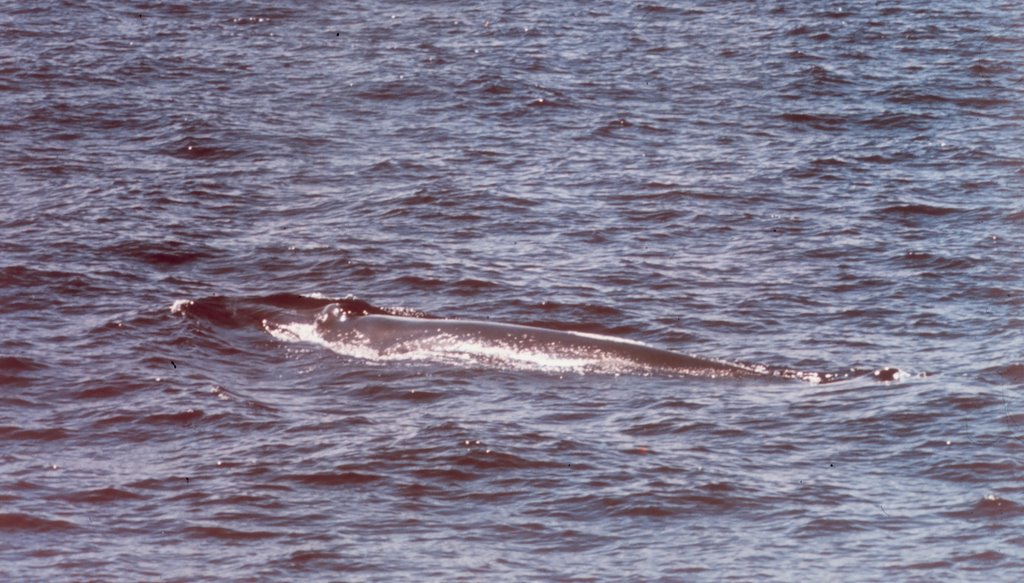
A dead fin whale was discovered floating in the Puget Sound near Everett, WA. The fin whale is the second largest whale, and, in fact, the second largest living animal. The recovered whale was still a juvenile, and measured a whopping 54 feet in length.

The Burke will become the home of this whale, but not for another 2-3 years. What’s the delay? Well, we’re letting this skeleton decompose in a whole new way…

Normally, to clean and prepare a whale skeleton for our collection, Burke researchers start by burying it in sand, allowing it to decompose. Then we scrape, cook, and clean the bones to remove any remaining muscle and tissue.

This time, the whale will be sunk off the coast of San Juan Island, where it will become the subject of an ecological study by UW’s Friday Harbor Labs and other researchers, tracking natural decomposition processes in an underwater environment (read: snails, worms, and other lovely things dining on the whale’s remains).

After 2-3 years of natural decomposition, the bones should hopefully be picked clean by ocean critters, then the bones will be retrieved and join the Burke’s mammal collection.

This is the first time the Burke is acquiring a skeleton through this novel method. Our curator of mammals, Jim Kenagy, is as excited about the process as he is about eventually receiving the bones. Along with the enormous skeleton, he hopes to have video of the seafloor activity, filmed during the years the whale is underwater, accessible to the public, perhaps online or in a Burke exhibit.

For those who have a strong stomach, keep an eye on this story. It’s not for the queazy.

- Rebecca


Photo provided by National Oceanic and Atmospheric Administration / Department of Commerce

AddThis