Showing posts with label whales. Show all posts

February 23, 2011

Burke Freight Elevator Tells All in Exclusive Interview

I first met our freight elevator, who I'll call Frank, when I started my job as the Burke receptionist back in August. He helped me get to my first interview and ever since we've been very close. Since he's only a few feet from my desk, Frank and I work together daily, which is why it was such a treat to spend a bit of time with him to check in and find out what this elevator's walls had to say.

Sam the Receptionist: Thank you, Frank, for sitting down with us today to discuss what it's like to work at the Burke.
Frank the Freight Elevator: You're welcome, Sam. It's a pleasure to be here. Of course, I appreciate you coming to me as it's difficult for me to get away from my post at times.

That's me and the freight elevator, conducting our interview.
S: No problem. I can imagine that, as a freight elevator, it's easiest for me to come to you. Of course, we work closely during the day and you help me quite a bit.
F: No worries, it's my pleasure. I am more than happy to help keep the museum working.

S: Well, let's get to it. How long have you been here at the Burke? 
F: I came to the Burke in 1962 and was lucky enough to start in this position. I didn't have to work my way up, so to speak. I work my way up every day! Ha! That one will never get old.

S: Haha, thank you for that. Is there a remarkable experience that you've had since you've been at the Burke?
F: There are so many amazing things that happen here. Of course, I enjoy the annual whale skull move for Meet the Mammals. It's nice to get to see such an incredible specimen up close like that. It's also really amazing how much work goes into getting them from the mezzanine to the second floor. Two years ago, someone caught me on video while our mammalogy team was moving the whale skulls...check it out: 


S: What about the day to day? What does a regular work day look like for you?
F: Well, the back side of the museum usually opens around 7:30 am or so and people start going to the different floors around 8 am. First the collections managers, curators, and staff show up and a few volunteers. I really love everyone who works here, but the volunteers are who make my day. Some of these people are here so long, I forget that they don't get paid! Like this guy Don, he's a volunteer in Geology and I swear sometimes he's here more than I am!

S: Aside from the people, what kinds of things do you see on a regular work day? What do you carry other than people?
F: WELL! That's very exciting. People from around the area here and a few different organizations bring us dead stuff. Yes. Dead stuff. My absolute favorite! People will bring in gorgeous birds that have flown into windows or were knocked out of a tree in the storm. Some of the most stunning specimens are brought in by the public. They find these unfortunate creatures outside and they wrap them up in plastic, stick them in their freezer and call the Burke to find out what to do next. Also, the Woodland Park Zoo and the Burke have a great relationship. A lot of the animals that pass away at the Zoo come to the Burke to be cleaned up and cared for and then become educational tools for teaching people about the amazing diversity of life on Earth!

S: It sounds like you have quite the job here at the museum.
F: Yes, it really is. I get to take people to where they need to go with the cool stuff that they work with here. There are so many fascinating things here at the Burke that even the freight elevator can get in on the action!

S: Well, thank you for your time, Frank. Hopefully we'll get a chance to meet with you again at some point to hear about your latest exploits!
F: Thank you, Sam. It's been a pleasure.

Posted by: Samantha Porter, Operations

April 14, 2010

Animals in the Spring

Although we have had some blustery weather over the last few days in the Seattle area, there is no doubt that spring is arriving. Not only are flowers and leaves peeking their way back into the landscape, but Washington state animals are starting some interesting activities as well. Here are a few things to look for around your neighborhood and around the Puget Sound.

Wood Peckers: You may have noticed already this spring that woodpeckers are pecking your house, trees and other parts of your neighborhood. There are a couple of different reasons why woodpeckers “drum” on houses. Searching for food is one reason, but did you know they may also be trying to attract a mate?

That’s right, drumming is used to communicate with other woodpeckers, and they tend to be at their loudest during their breeding season in early spring. In order to get the point across and make the drumming even louder, woodpeckers have been known to drum on flashing around chimneys (thus the rooftop noise), siding and even metal street lamps!

Hairy Woodpecker, photo by Stuart MacKay

Once a woodpecker has found a mate, your house will likely go unnoticed by the neighborhood woodpeckers.

Male American Robins: Is a robin attacking your windows every morning? It may be startling, but the bird is not injuring itself. Instead, this noisy and disruptive behavior is due to a male robin seeing his reflection in the window pane. Male robins get particularly territorial during their mating season in early spring, and will come back repeatedly to your windows to check up on this “invader.”

Male American Robin, photo by Stuart MacKay

Just like the wood pecker, this behavior only lasts for a short period of time. However, for your sanity, click here to find out ways to reduce reflections on your windows.

Orcas: The three pods that inhabit Puget Sound, known as the southern resident killer whale population, return to the area in May to follow salmon runs until October. Popular routes for the Puget Sound’s three orca pods in the spring are generally around the San Juan Islands. If whale watching boats aren’t your style, people often see orcas from the state parks on the islands.


Orca Whale, photo by http://www.flickr.com/photos/ephotion/255115491/

Eastern Cottontails: If there are rabbits that hang out in your backyard or neighborhood park, you may see some interesting mating displays. Eastern cottontails, common in the Seattle area, have a mating season of February-September. The males fight each other and do dance-like courtship displays. These displays include group chases and lots of jumping, including females jumping over males.

Eastern Cottontail

Keep an eye out for these interesting creatures and enjoy your spring!

Posted By: Andrea Barber, Communications

June 13, 2008

A Whale of a Tale!

We have a great new video podcast out- check it out. In it, Burke Curator of Mammals, Jim Kenagy, narrates the sinking of a deceased fin whale and subsequent underwater exploration to the same site.

For more about the story, click here.
Dr. David Duggins, a Friday Harbor Labs research scientist, winching up the fin whale cranium.
Photo by Robert C. Williams

May 21, 2007

Bon Voyage!

Posted by: Karyn Gregory

Just a bit south of here, two humpback whales – a mother and calf – have finally started home after swimming 90 miles through the San Francisco Bay and ending up in the Sacramento-San Joaquin Delta. They were spotted heading for the Sacramento harbor on May 13, arrived on the 15, and have been attracting massive crowds of whale watchers to the area. Ever since then scientists have attempted to lure them out before the whales hurt themselves. Biologists are concerned because "...they are at the end of their hibernation season, [therefore] they have less blubber to rely on for fuel than they would later in the summer or fall."

First, the scientists tried playing whale songs and when that didn’t work, they planned on scaring them with loud underwater noises. Fortunately, it looks like the whales came up with their own idea and began following two tugs out of the Port of Sacramento towards the Pacific Ocean. They still have a long way to go, but it looks like they’re on the right track. Keep it up you guys!

You can see video of the whales on KIRO TV here.

-Karyn

Photos
Top left: Humpback mother and calf, courtesy of OAR/National Undersea Research Program (NURP)
Bottom right: Humpback tail flap, courtesy of OAR/National Undersea Research Program (NURP)

March 28, 2007

Baby Orca Brings Hope

Posted by: May Evans

A new orca calf brings the endangered Puget Sound orca population up to 86.

Puget Sound is home to 3 pods, or groups, of Orca whales for at least 6 months out of the year. The pods, designated by the letters K, J, and L, provide scientists with a means of understanding the influence of humans on the health of Puget Sound. According to Bob Lohn, head of the NOAA Fishery Services Northwest regional office in Seattle, “These animals are part of Puget Sound’s cultural heritage and its ecology. We have an obligation to see that this population once again thrives.” This past fall, with the deaths of three adults and two calves, the pod population dropped to 85. But now, a new calf has been born.

L109, as the newest member of the L-pod, faces what could be a very difficult year. Scientists are unsure of who mothered the calf, but they have narrowed down the possibilities to two adult Orcas, a mother and her daughter. Orcas are contaminated with industrial chemicals and these collect in the fatty tissue and milk. These pollutants are then passed on to the first and second calves born to a mother. After that, "the mothers sort of clean themselves out," according to Ken Balcomb, a senior scientist at the Center for Whale Research. So if L109 belongs to the mother, it has a greater chance of survival because it will be her third calf, but it would be the daughter’s first, making it more susceptible to premature death. Experts say that if L109, whose gender has yet to be determined, survives through the summer, it has a good chance of living a full life.

The calf gives new hope to NOAA Fisheries Service, which has set its goal for local Orca recovery at a stable population of 120 animals. The most pressing dangers facing the whales are pollution, oil spills, the effects of boat traffic, and a lack of food. NOAA is working to combat these threats, and is seeking suggestions regarding the reduction of boat traffic-related trauma on the whales. Public hearings start in April, and in the meantime, be sure to download the “Whale Wise” boating guidelines.

-May

Photo by Nancy Black, Monterey Bay Whale Watch

November 22, 2006

Burke Catches a Whale

Posted by: Rebecca Durkin


It’s in the news:
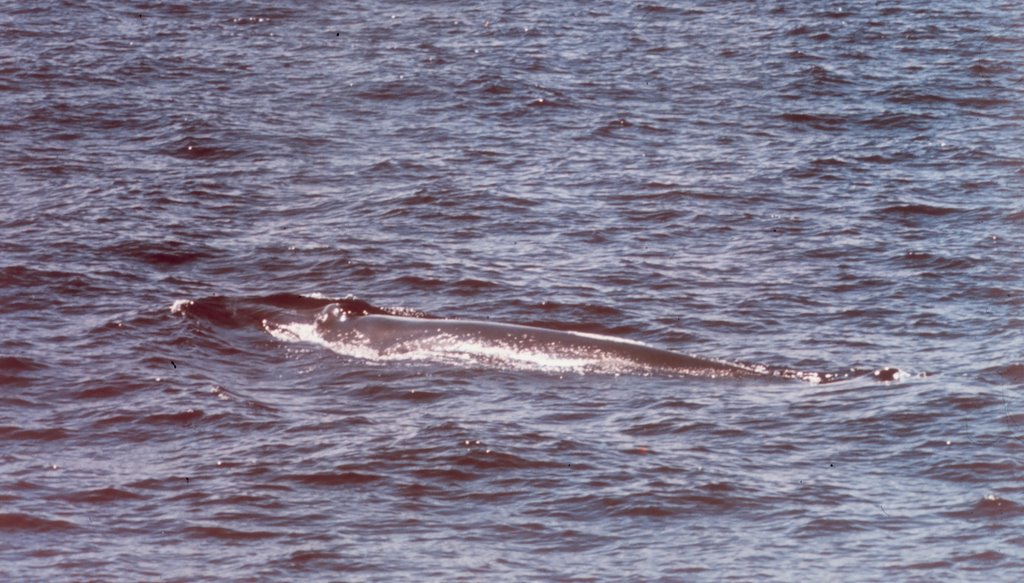
A dead fin whale was discovered floating in the Puget Sound near Everett, WA. The fin whale is the second largest whale, and, in fact, the second largest living animal. The recovered whale was still a juvenile, and measured a whopping 54 feet in length.

The Burke will become the home of this whale, but not for another 2-3 years. What’s the delay? Well, we’re letting this skeleton decompose in a whole new way…

Normally, to clean and prepare a whale skeleton for our collection, Burke researchers start by burying it in sand, allowing it to decompose. Then we scrape, cook, and clean the bones to remove any remaining muscle and tissue.

This time, the whale will be sunk off the coast of San Juan Island, where it will become the subject of an ecological study by UW’s Friday Harbor Labs and other researchers, tracking natural decomposition processes in an underwater environment (read: snails, worms, and other lovely things dining on the whale’s remains).

After 2-3 years of natural decomposition, the bones should hopefully be picked clean by ocean critters, then the bones will be retrieved and join the Burke’s mammal collection.

This is the first time the Burke is acquiring a skeleton through this novel method. Our curator of mammals, Jim Kenagy, is as excited about the process as he is about eventually receiving the bones. Along with the enormous skeleton, he hopes to have video of the seafloor activity, filmed during the years the whale is underwater, accessible to the public, perhaps online or in a Burke exhibit.

For those who have a strong stomach, keep an eye on this story. It’s not for the queazy.

- Rebecca


Photo provided by National Oceanic and Atmospheric Administration / Department of Commerce

November 15, 2006

Remains of Sunken Whale Skeleton Resurface

The cranium of a whale skeleton that has been on the ocean bottom near the San Juan Islands since November 2006 (see video footage below) finally resurfaced on Sunday, June 1, after a long, exhausting weekend for a team of University of Washington Friday Harbor Lab divers and vessel operators.

Bringing the 9 1/2-foot-long cranium of a large male fin whale to the surface was a precarious and challenging task. Divers spent two days preparing straps and lines before they were finally able to retrieve the large, unwieldy object and hoist it onto the deck of the Centennial, a UW research vessel. The other pieces of the skeleton, including two jaw bones, remain on the seafloor in the San Juan Islands. According to Jim Kenagy, Curator of Mammals at the Burke, this procedure is a novel attempt to add to the museum’s mammalogy research collection, which already contains over 50,000 specimens.


Fin whale cranium is retrieved after eighteen months on the sea floor.
Photo by Robert C. Williams
The 54-foot carcass was initially recovered near Everett, Washington, in autumn 2006, after the animal had died from being struck by a large ship. The Burke Museum partnered with the University of Washington’s Friday Harbor Labs to employ an innovative method for preparing the skeleton.

In November 2006, the recovered whale was towed by the UW’s Centennial to the San Juan Islands. A research group, led by David Duggins of the Friday Harbor Labs, sank the carcass to a depth of about 120 feet. The whale remained on the bottom, where it naturally decomposed, for 18 months. This is the first Burke whale specimen to be obtained by these unusual means.

Dr. David Duggins, a Friday Harbor Labs research scientist, winching up the fin whale cranium. Photo by Robert C. Williams

The sinking of the whale carcass provided marine scientists a special opportunity to investigate the natural process of decomposition and nutrient recycling that occurs on the ocean floor. Dr. Craig Smith of the University of Hawaii leads a team of researchers who track this ecological process.

On Sunday, the whale’s cranium was brought to the surface by a dive team led by UW diving safety officer Pema Kitaeff. The divers included local San Juan Islander Kurt Long and three others from Western Washington University’s Shannon Point Marine Center: Nate Schwarck, Karl Mueller, and Robert C. Williams.

The UW Friday Harbor team has used a ROV (remotely operated vehicle), underwater photography, and divers to document the complexity and dynamics of the ecological community that has benefited from the decomposition of the fin whale.
Vertebrae of a fin whale. Researchers sank the deceased whale's carcass in order for it to be cleaned naturally by biological organisms on the sea floor.  Photo by Robert C. Williams

Video ~ Behind the Scenes: The Fin Whale
Curator of Mammals, Jim Kenagy, narrates the experimental sinking of a deceased fin whale and subsequent underwater exploration to the same site.  To watch the video, click here.

AddThis